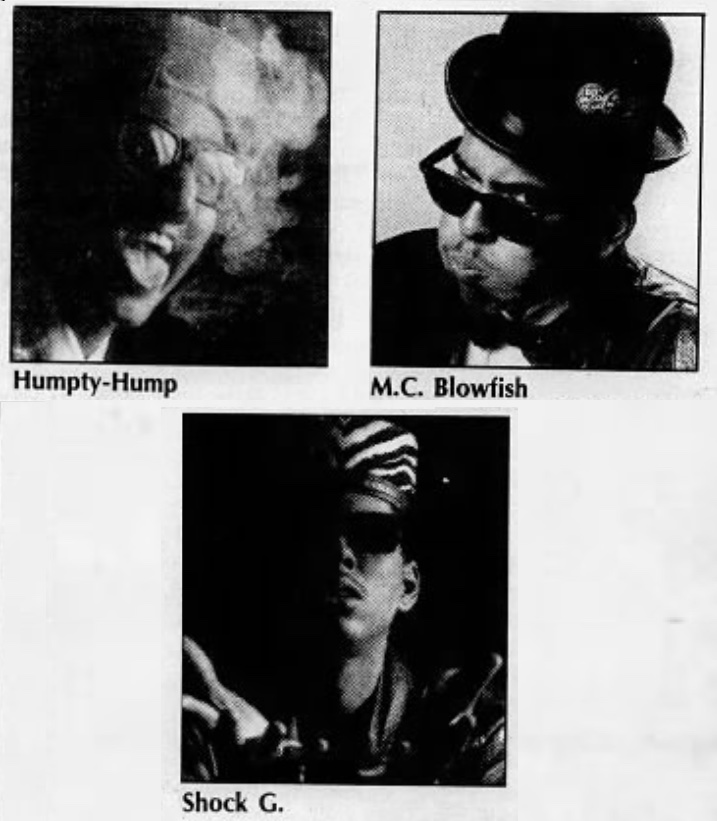
Debuting with a song about eccentric tales of life underwater by using an abundance of aquatic metaphors could have relegated any artist to comedic obscurity. Fortunately, there was more promised to the prospects of Digital Underground – who emerged in 1988 with the aptly-titled “Underwater Rimes”. The track features frontman Shock G making seemingly boundless oceanic references before he clears the way for his partner M.C. Blowfish: a deep-voiced maritime mobster who boasts of his deepwater exploits and ends his verse by puffing up in the recording booth.
M.C. Blowfish was credited by the group as being its most pivotal member. In a 1991 interview with The New York Times, Shock G explained that he knew the “aquatic musical creature” from his days in Tampa, Florida, but M.C. Blowfish was known to “swim all over.” One such voyage took him to the coast of San Francisco where DJ Fuze was caught in an undertow until Blowfish taught him how to swim parallel to the shore. DJ Fuze knew a local rapper, Money-B, and Digital Underground was formed by the subsequent mutual connections.
Two years later after “Underwater Rimes”, Digital Underground achieved national success with “The Humpty Dance” which explores the fantastic life of the carefree, lively and excessively horny Humpty Hump. Across the song, Humpty Hump (real name: Edward Ellington Humphries III) confidently portrays his sexual exploits, general success and personal popularity to mock his inferior competition. “The Humpty Dance” – over a woozy bassline that arrives and then recedes almost like waves on a shore – concludes with instructions on how to perform the dance of its title which, if performed correctly, is “supposed to look like a fit or a convulsion”. Humpty Hump achieved attention for his own appearance: exaggerated pimp-like outfits with fur robes and fur hats that were accompanied with sunglasses attached to an oversized plastic nose.
It was seemingly a remarkable recovery for Humpty Hump who had his career in turmoil and was seeking a new direction when he joined Digital Underground. Smooth Eddie Humphrey – as he was previously known – was a promising lounge singer in Florida who had his throat damaged and his nose disfigured in a kitchen accident. To save his musical prospects, he converted himself into a rapper and donned a plastic nose; Shock G stated that he “wanted to work with him but he had to do something about that nose.”
It is amusing to read The New York Times article because of the author’s suspicions at the time: “M.C. Blowfish, it must be said, bears an uncanny resemblance to Shock G; Shock G also seems suspiciously similar to Humpty Hump.” Of course, despite the group’s best efforts at maintaining some aspect of believability, it was too obvious. Digital Underground used doubles in music videos but apparently had difficulty at their live shows as Shock G needed to perform multiple roles often in the same song. There were some other obvious signs too like M.C. Blowfish’s sole promotional picture which depicts an obvious Shock G wearing a bowler hat and puffing his cheeks. It was true: Shock G played both characters.
Shock G performed in other realms too. He was credited as The Piano Man for his contributions on the keys across his productions. As an artist, he was known by Rackadelic for his cartoonish drawings that often adorned Digital Underground’s releases. His final character was Peanut Hakeem Anafu Washington, an attorney poised against Shock G in a courtroom skit on Digital Underground’s album Who Got the Gravy?.
Shock G’s creative exploits in humour and performance could have easily seen him transition into a talented sitcom writer or standup comic. He instead devoted his creative gift to Digital Underground. The group could have been mired in the tragic realm of “comedy hip hop” but it was Shock G’s artistry that ensured the group was always more. He penned socially-conscious songs like “Heartbeat Props” and “Wussup wit the Luv”. He nurtured talent like Tupac Shakur, Luniz and Saafir. He had an ardent devotion to Parliament–Funkadelic that saw that Digital Underground be akin with its wide range of personalities and specialties that were to advance together as one creative unit.
Shock G was a presence like no other in hip hop. It was fortunate that the entire encapsulation of his abilities found its outlet with Digital Underground.


Leave a comment