For anything in life that is now regarded as the expectation, there was someone who first did it as the exception. The act can sometimes be performed in such a deficit of attention that the notoriety to follow others doing the same never makes it back to the originator. Such is the case of Philmore Westbrook.
Westbrook did something 54 years ago that is now so common it even has its own name: one-and-done. The term covers the process of participating in collegiate athletics for one season and then pursuing a professional career. The NBA – with only short periods of relinquishment – generally prohibits players from joining the league immediately out of high school. This has meant that the pathway to a basketball career is mandated for the majority of players: high school, four years in college, and then a chance to go professional. Some might start their careers in other leagues or by sitting out a year before applying for entrance. The other option is usually reserved for the highest rated prospects: declaring for the draft as an early entrant and departing college prematurely.
The NBA first introduced the early entrance system in 1971 through a hardship draft to accomodate collegiate players who faced financial difficulties and would have benefitted from an earlier start to their professional careers. The NBA combined the hardship draft idea with their standard draft format the following year and allowed for hardship cases to apply for entry. The need for players to apply because of financial circumstances was eventually eased and it became the pathway for obvious professional prospects to pursue opportunities beyond college at an accelerated pace.
Early entrants are the standard for the NBA draft nowadays. Each year sees many underclassmen aspiring for the greatest of highs in their basketball career with an admission into the top league. The top ten players selected in the 2025 NBA draft were college underclassmen; nine of them were freshmen. In the 2026 NBA All-Star Game, 21 players had played college basketball in the United States but only one (Norman Powell from UCLA) was a college senior. Reigning two-time MVP Shai Gilgeous-Alexander was a one-and-done at Kentucky. Many of the greatest players in the world experienced one year at college and then went on to the staggering heights of their professional careers.
Someone had to be the first to do that though. In 1972, the year that the NBA introduced early entrants into their draft, six collegiate players applied as hardship cases. It was a sundry crew with varying degrees of likelihood. Juniors Bob McAdoo from North Carolina and Brian Taylor from Princeton were considered definite prospects and both enjoyed lengthy professional careers. Sophomore Michael Reid from UC Riverside was drafted but did not play professionally. Nobody considered sophomore John Tinsley from Pfeiffer and Walter Gardner who had dropped out of Kaskaskia two years earlier; they never played again. There was also little attention paid to Philmore Westbrook from the College of The Albemarle (COA) – the first one-and-done in NBA history.
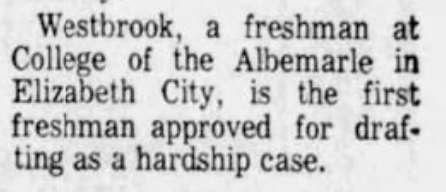
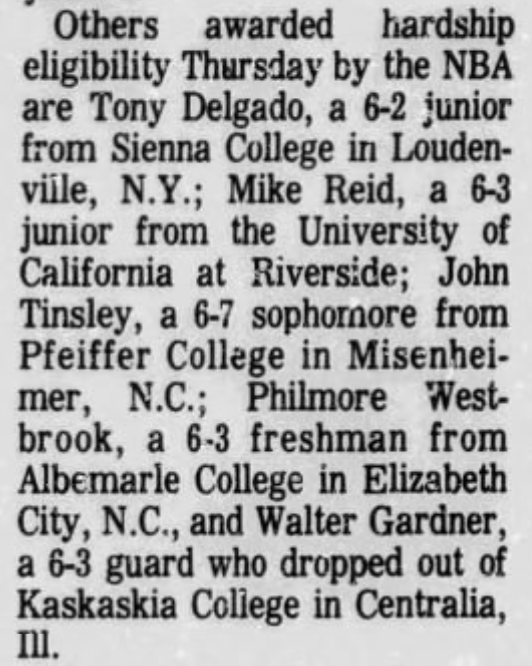
Westbrook was a 6’3″ freshman from the COA Dolphins in Elizabeth City, North Carolina. Him being the first ever freshman draft entrant received a mention in The News and Observer from nearby Raleigh. That is basically the extent of published information about Westbrook in 1972 news articles. No statistics, interviews or draft analysis of him were published. Westbrook was undrafted and never played professionally.
The last detailed mention of Westbrook in contemporary coverage was in a 1976 article by The Charlotte Observer. Writer Frank Barrows described Westbrook as “a guard whose eyes were pensive and whose athletic skills were decent but no more.” He recounted that the last story he had heard about Westbrook was that his clothes and suitcase were impounded by a hotel to cover his bill. There was to be no great fame for Westbrook like many of those who were to follow him.

Westbrook likely declared knowing that making the league from where he was would have been a monumental task. COA is a two-year public community college that had a student population of 950 in 1972. Established in 1961 in a former hospital on the bank of the Pasquotank River, its open admissions policy meant it accepted any student who had graduated from high school. The basketball team was a member of the Cavalier Tarheel Conference in the National Junior College Athletic Association. COA discontinued its athletics program in 1977 and has never reinstated it.

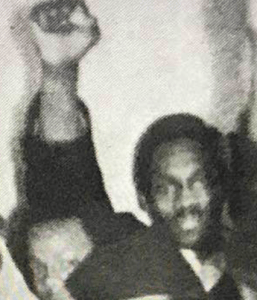
Even searching Westbrook’s name today, there is almost nothing published about him. Through the sparse Facebook recollections I could find, Westbrook was a native of New York City and played at tournaments held on the basketball courts of the Brevoort Houses in Brooklyn during the 1970s. He is identified in only one published picture; a solemn figure captured in the background while holding a black power salute. Westbrook is noted as being deceased in the obituary of his brother, Donald, published in 2016.
Every year, NBA draft hopefuls sacrifice their collegiate career to dream big and aspire for the early bestowal of professional belonging. For most, it is accompanied with fame, fortune and the creation of legacies on a basketball court. For the first freshman to pursue those same dreams, carved on a community college campus in rural North Carolina far away from the big city courts of his hometown, they were performed in obscurity for a destiny that was to be beyond his reach.
What could never be taken away is Westbrook being the first. Any freshman that declares for the draft is following the lead of someone who probably was never told nor realised that he did something special.
[Update 22/8/26: Big shoutout to Matthew Maurer of The Draft Review who uncovered some additional biographical information on Westbrook and published it here. Westbrook never played at COA because he was academically ineligible; he declared for the draft aged 22 without ever having played a game in college. He died in 1997 aged 47.]


Leave a comment