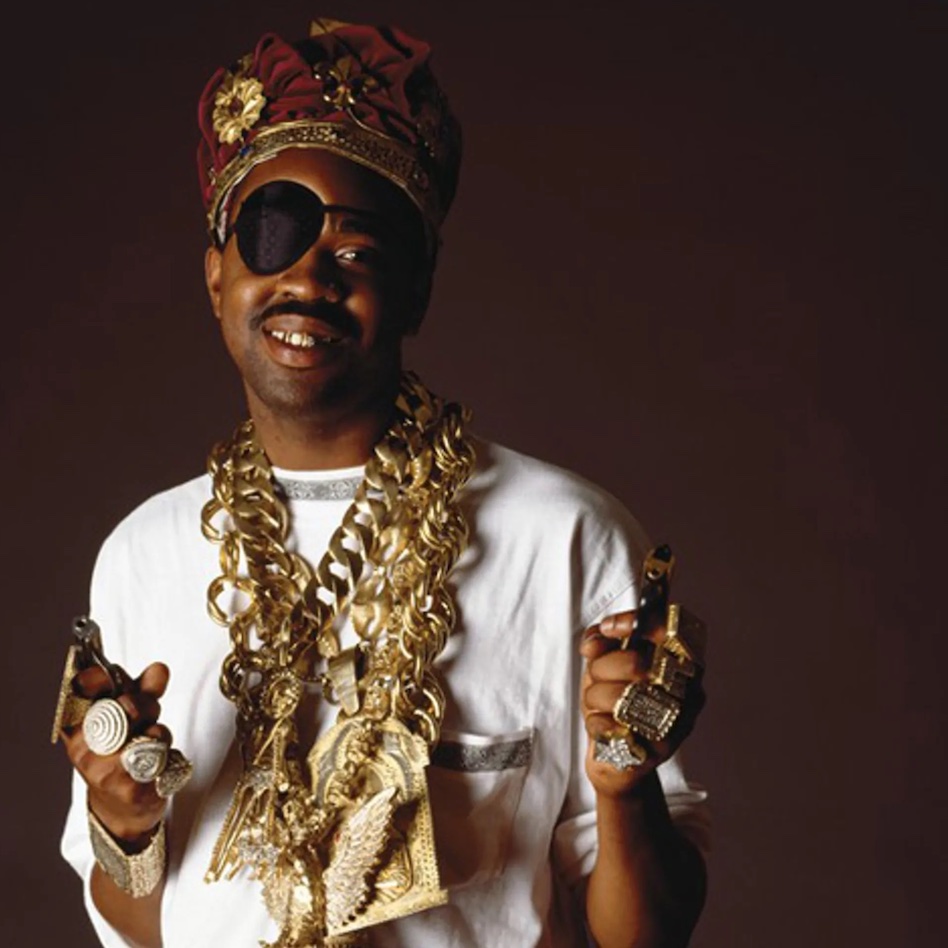
When writing about the release of Slick Rick’s latest album VICTORY a few days ago, I remarked in the first paragraph about the mere accomplishment of overcoming hip hop’s longstanding ageism. VICTORY was released 37 years after Slick Rick’s debut album The Great Adventures of Slick Rick and 40 years after he made his magnificent debut as M. C. Ricky D alongside Doug E. Fresh on the seminal “The Show” / “La Di Da Di” single. Almost an entire half-century since he made his first impression and Slick Rick has released a body of work that shows no suggestion of him slowing because of age.
It has been a full 40 years for Slick Rick during that time. His debut appearance on “La Di Da Di” ended up being his only release until 1988 when his first solo material emerged. That time period of aloofness sprouted rumours as to the reasoning for his absence; a 1991 article in Spin notes theories that include Slick Rick on drugs, being stabbed or in a mental hospital. The noise was settled once The Great Adventures of Slick Rick debuted in 1988. It first reached the Billboard charts in 1989 and peaked the Top R&B/Hip-Hop Albums listings in May of that year – a whole seven months after it first came out. Slick Rick had tremendous ego – a 1989 interview with the Los Angeles Times quotes him as saying, “I’m a great rapper. I have insight. I have humor. I have it all” – yet he portrayed himself as a man of morals in disarray. The tender “Teenage Love” was contrasted with the dismissive “Treat Her Like a Prostitute”; he was accused of misogyny which he dismissed as his attempts at sarcasm. The cautionary tale “Children’s Story” sits in direct contention with the following song “The Moment I Feared” which is a first-person tale of Slick Rick being confronted while having an affair with a drug dealer’s girlfriend and results in him being imprisoned. Slick Rick described the track as “envisioning himself”; an ideation that became reality when he was perhaps the first prominent figure in hip hop to face incarceration.
It was a combination of violence, family and paranoia that saw Slick Rick become another case about the wrong path. In April 1990, he was the victim of a robbery, had his car riddled with gunfire and was grazed by a bullet in an incident outside a Bronx social club. One of the alleged perpetrators was a cousin who had worked as Slick Rick’s bodyguard but developed a violent grudge after he was fired. In July, Slick Rick was driving around Queens with his pregnant girlfriend when he saw two men involved in the robbery standing on a street corner. He circled back and started shooting; he hit one of the men in both feet and the other in the leg and abdomen. Slick Rick raced up the block doing eighty-three and led the police on a chase until he crashed into a tree in the Bronx. Escaped alive though the car was battered, Slick Rick and his girlfriend jumped out but – before long – the young man and woman got surrounded. Slick Rick did not have a gun to drop on him at the time of his surrender – so neither did the police shoot him – but officers found six fully-loaded weapons in his vehicle including a shotgun that was reported as stolen by the Richmond Police Department (as opposed to Dave, the dope fiend shootin’ dope who don’t know the meaning of water nor soap).
A broken leg suffered from the crash was not all that Slick Rick had to recover from. He then had to face the legal repercussions of his actions; in the midst, he recorded his second album, The Ruler’s Back (1991), during a brief period of bail. His claim of self-defence was disregarded and Slick Rick was sentenced to prison for attempted murder, assault and criminal possession of a firearm. Slick Rick finished his third album, Behind Bars (1994), during a work-release respite in 1993. He also faced the risk of deportation; the British-born rapper had not attained citizenship at the time of his arrest (a 1995 Daily News article mentions “recent Republican calls to have all “criminal aliens” deported” – not much has changed today) but managed to avoid being forced out of the United States. He makes a haunting appearance in the 1995 documentary The Show as the once untouchable entertainer who has been locked away in the shroud of prison.
Slick Rick was released from prison in 1996. His fourth album, The Art of Storytelling, came out in 1999 and was heralded as marking a comeback. Slick Rick’s citizenship status came back to trouble him in 2002 when he was arrested after attempting to re-enter the United States through a law that allowed the deportation of foreigners convicted of felonies. Progress was halted on an album that he had been working on and planned to call either Ferocious or The Adventures Continues. Slick Rick was held in custody until he was released in 2003. Slick Rick was the subject of another unsuccessful deportation attempt in 2006. He was granted a full and unconditional pardon on his 1990 attempted murder charges by the governor of New York in 2008. Another anniversary of 40 years was an important milestone in Slick Rick’s life: 2016 saw him receive American citizenship after first arriving in the United States in 1976.
No longer faced with the threat of being deported from his home since childhood, Slick Rick must have felt a comfort return. VICTORY could stand for many aspects of his life: victory in longevity, victory through captivity or victory over declivity. The ruler’s back when he fortunately never truly left.


Leave a comment